

What the Mobile Gaming Audience Actually Looks Like in 2026

The mental model some brand and agency teams still carry into a mobile gaming buy is overdue for an update. Young, mostly male, casual puzzle play: it's a shorthand that still shapes a surprising number of media plans and category assumptions. The data, on the other hand, has moved on.
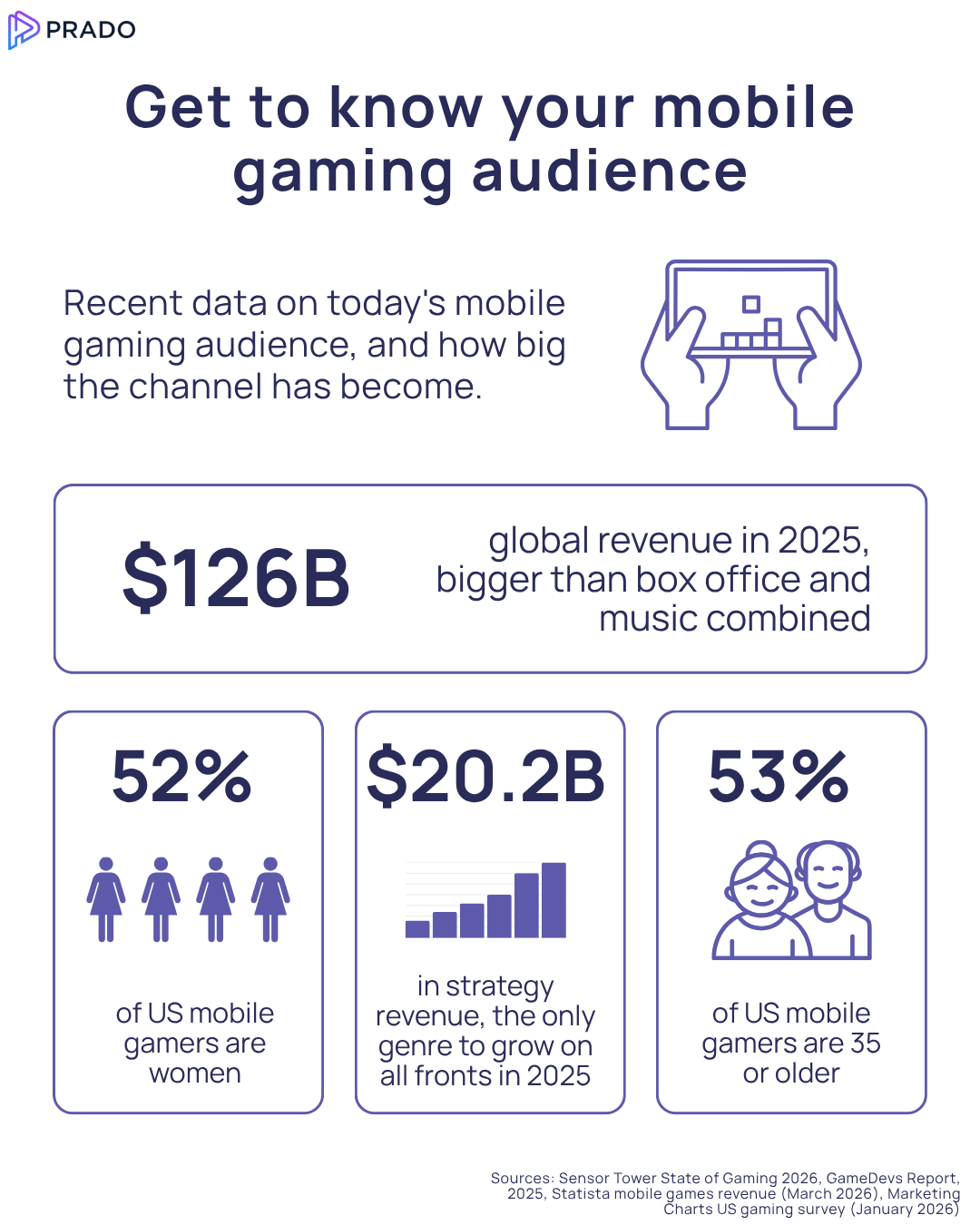
A January 2026 survey from Marketing Charts found that 53% of US adult mobile gamers are 35 or older, and 52% are women, close to the makeup of the general US adult population. Global mobile gaming revenue reached roughly $126 billion in 2025 according to Statista, larger than the global box office and recorded music industries combined.
The shift shows up in what people play, too. While puzzle still leads by volume, Sensor Tower's State of Gaming 2026 found strategy was the only mobile genre to grow on revenue, downloads, and time spent in 2025, earning $20.2 billion that year, a small but high-spending slice of the market that tends to skew older.
The harder part isn't seeing the data: it's acting on it. Reaching this audience inside mobile games means knowing which games fit a campaign and understanding the moment a player is in, and doing it while privacy changes make older targeting methods less reliable outside the big platforms.
That's the gap Prado works to close. Rather than relying on user identifiers that are disappearing, Prado reads the context of the game itself to place ads where they fit and measure whether they landed. The engine behind that is Kite IQ, Prado's contextual intelligence system. The result is a mobile gaming buy built on the audience that's actually playing, not the one in the brief.
The audience has shifted and the channel as seen has scaled. The plan should reflect both. Is the mobile gaming audience in your next campaign the one in the data, or the one in the assumption?
Build the next plan around the audience that's actually playing → Talk to Prado


.png)


